
How to Choose the Best Cat Bed?
Choosing the right cat bed is less about finding the trendiest design and more about understanding how your cat already sleeps. One cat may curl into a tight ball.
Another may stretch across the sofa. A third may hide in the quietest covered space at home. Size, sleeping posture, privacy, warmth, and placement all help determine whether someone loves a new bed or ignores it.
This guide compares popular cat beds and answers the questions shoppers commonly ask before buying. It also explains when a donut cat tunnel bed may be useful for a cat. This cat may switch between open lounging and private hiding.
Do Cats Truly Need a Cat Bed?
A cat does not need an expensive cat bed. Every cat should have a comfy place to rest undisturbed. A cardboard box with a familiar blanket may suit one cat, while another may prefer a raised cushion or a hideaway.
The Feline Veterinary Medical Association includes comfortable and safe resting places among the essential resources for indoor cats. Cats Protection also notes that cats often change where they sleep. They usually choose places that feel warm, comfy, and safe.
Providing more than one option lets a cat choose based on temperature. It can also choose based on room activity and its need for privacy.
Quick Guide: Match the Bed to the Sleeper
Before comparing colors or fabrics, watch your cat’s normal sleeping behavior.
• A cat that curls tightly may like a donut cat bed with a defined outer edge.
• A cat that hides in boxes may prefer a covered cat bed or cave-style design.
• A cat that explores beneath furniture may enjoy a cat tunnel bed.
• A cat that stretches across the sofa may prefer a flat cushion or sofa-style lounger.
• A cat that switches between watching and hiding may like a donut cat tunnel bed. It has separate upper and lower areas.
These are useful starting points rather than guarantees. Individual cats can change preferences with the season, time of day or location of the bed.
What to Look for When Choosing a Cat Bed
Sleeping Position and Usable Space
Measure the space your cat occupies when resting naturally. A curled sleeper needs enough internal room to turn and settle, while a sprawler needs more length. For cave and tunnel designs, compare the entrance and internal dimensions rather than relying only on the outside diameter.
The bed should not force the cat into one fixed posture. Kittens need room for growth, and larger cats need enough clearance to enter and leave comfortably.
Open or Enclosed Design
Open beds give cats a broad view of the room. They may appeal to confident cats that enjoy monitoring people, other pets or activity outside a window.
Enclosed designs add more visual separation. They may suit cats that already sleep in boxes. They may also suit cats that sleep beneath furniture or behind curtains.
Never force a hesitant cat into an enclosed space. Position the opening where it remains visible and accessible. If the design has only one entrance, do not place it against a wall or where another animal could block it.
Entrance Height and Accessibility
Young, healthy cats can step over a high border with ease.
Senior cats and cats with limited mobility may need a lower entrance and firm footing. They may also need a sleeping area that does not shift.
Whatever the style, the base should sit securely on a level surface. Stop using any product that tips, collapses or develops an obstructed entrance.
Materials and Cleaning
Look for secure seams, a stable structure and care instructions that suit your household. Removable cushions, easy-to-reach interiors, and separable sections can make routine cleaning easier. Check a zippered product regularly around the zipper tape, pull, and adjoining seams.
Do not assume every fabric product is machine washable. Follow its care label, vacuum loose fur as needed and allow every part to dry fully before returning it to your cat.
Popular Cat Beds Compared
Donut Beds
A donut cat bed has a round sleeping area with a raised edge. It often suits a cat that curls up, nests or rests its head against a border. Traditional designs are open on top, whereas a structured donut cat tunnel bed adds a second resting area underneath.
Cat Couch
This sofa-style bed resembles a miniature couch or chaise. Its open shape may suit a cat that stretches out or enjoys sleeping on human furniture. Compared with a deep round design, it generally provides a clearer view and less enclosure. Choose according to posture rather than appearance alone.
Covered Cat Bed and Cave Styles
This enclosed style creates a clear retreat from busy household activity.. It may appeal to cats that regularly choose closets, boxes or spaces beneath furniture. Check that the structure holds its shape, offers sufficient internal room and allows the cat to leave without difficulty.
Tunnel styles add an exploratory element, but the space should still function as an accessible resting area. In a multi-cat household, make sure one cat cannot easily trap or block another inside.
Heated Options
A heated cat bed may help in cool indoor spaces.
But it is a different product type.
The donut tunnel shown here has no heating element. Choose a pet-specific product only.
Follow the product instructions.
Inspect electrical cords.
Make sure the cat can move away from the heat. Ask a veterinarian for guidance if an older, hairless, unwell or mobility-limited cat appears unusually sensitive to temperature.
Is a Donut Cat Tunnel Bed Right for Your Cat?
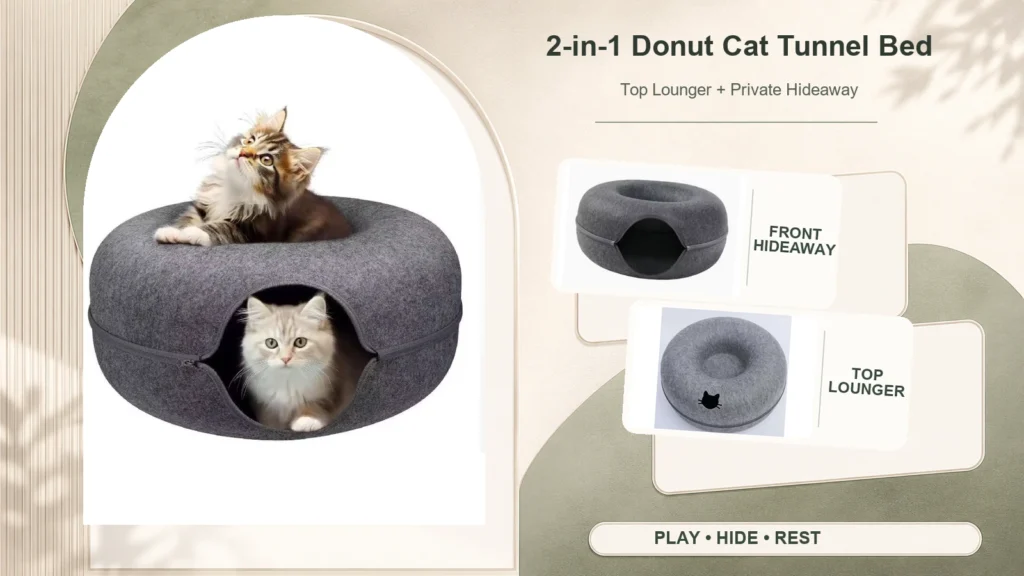
The main advantage of a two-level design is choice. The recessed upper surface offers an open place for lounging and observing, while the lower compartment provides more enclosure. A cat can move between the two areas as its preference changes through the day.
The vertical layout also creates two resting zones without taking the floor space of two separate furniture pieces. In a compatible multi-cat household, one cat may rest above while another uses the lower area. However, owners should still provide extra sleeping options because not every cat pair wants to share.
Our 2-in-1 donut cat tunnel bed has a rounded top lounger and an arched lower entrance.
It also has a zippered, two-piece design for easier access during routine care. Designers chose its neutral gray look to match modern indoor spaces. It gives cats both open and covered options.
Where Should You Put a Cat Bed?
Start with a place your cat already selects for naps. A quiet corner of a bedroom, living room or home office may work better than a busy hallway. Keep the area dry, stable and away from strong drafts, noisy appliances, open flames and direct heat.
Some cats want to remain near their people without sleeping in the middle of household traffic. Others prefer a more private room. If your child ignores the new bed, move it to an established sleeping locati0n before you decide the design doesn’t work.
Browse our Cat collection to find more indoor resting and play options, and place them in different parts of your home. Multiple choices are especially valuable where several cats share space.
How Many Cat Beds Does a Multi-Cat Home Need?
Even cats that sometimes sleep together should have access to separate resting places. Spread the options across different areas. This way, one cat cannot control every route or resource. Watch for staring, chasing, guarding or blocking the entrance to a covered space.
A two-level bed adds choice, but it does not replace independent sleeping areas. Each cat should be able to rest and leave without another animal challenging it.
Frequently Asked Questions
Do cats prefer open or covered beds?
Some cats prefer an open view, while others choose enclosed hiding places. Observe whether your cat normally sleeps on chairs and windowsills or inside boxes and beneath furniture. A two-level design offers both types of space.
Is a sofa-style lounger better than a donut design?
Neither is universally better. A sofa shape may suit a cat that stretches out, while a round raised-edge style may suit a cat that curls and leans against a border.
What size cat bed should I buy?
Choose enough room for your cat to turn and settle in its normal sleeping position. For a cave or tunnel, check the entrance and usable interior separately. Senior or mobility-limited cats may need a lower opening.
Why does my cat sleep beside the new bed?
The location may be attractive even when the bed’s smell, temperature, size or shape is not. Try moving it to a familiar nap spot and adding an item carrying your cat’s scent.
Can two cats share one bed?
Bonded cats may choose to share, but it should remain voluntary. Provide other sleeping spaces so neither cat has to compete for access.
Is a heated bed necessary for indoor cats?
Not automatically. A healthy cat living in a comfortably heated home may simply need a warm, draft-free resting place. Select and use pet-specific warming products according to their safety instructions.
Final Thoughts: Choose for the Cat You Have
The best cat bed for indoor cats is the one that matches real sleeping habits. Consider posture, privacy, warmth, access, cleaning requirements and locati0n before focusing on color or trend.
An open lounger may suit a watcher. A rounded edge may suit a curler. A covered space may suit a cat that likes to retreat.
For cats that move between open and enclosed spaces, a donut cat tunnel bed offers two options in one compact design. Compare the measurements with your cat, place the product in a familiar quiet location and allow exploration without pressure. A thoughtful match between design and behavior gives the new resting place a better chance that people will use it.